Best Web Hosting 2026: Top 5 Picks Tested for Speed, Price & Support
Best web hosting 2026 — Hostinger, Bluehost, SiteGround & more compared on real speed, pricing & support tests. Find the right host for YOUR website today.

⚠️ Affiliate Disclosure: This post contains affiliate links for the hosting providers mentioned. If you purchase through these links, I may earn a commission at no extra cost to you. Rankings are based on independent research, real speed test data, and hands-on testing.
Introduction: Choosing Hosting Is the Most Important Decision You Will Make
Before you write a single blog post, before you design a single page, before you pick a theme — you have to choose where your website actually lives.
Get this decision wrong, and you will spend the next year fighting slow load times, confusing support tickets, and surprise renewal bills. Get it right, and hosting becomes the one part of your blog you never have to think about again.
I have spent weeks researching, testing, and comparing the most popular web hosting providers of 2026 — analyzing real speed benchmarks, uptime monitoring data, renewal pricing, and verified user reviews from Trustpilot and independent testing labs — to build this list.
This is not a generic “top 10” roundup copied from provider marketing pages. Every host on this list has been evaluated against the same five criteria: speed, uptime, pricing (including renewal cost), support quality, and beginner-friendliness.
The quick verdict for 2026: Hostinger wins for value and speed. SiteGround wins for performance and support quality. Bluehost wins for absolute beginners who want guided hand-holding. Let’s break down exactly why, and help you find the right match for your specific situation.
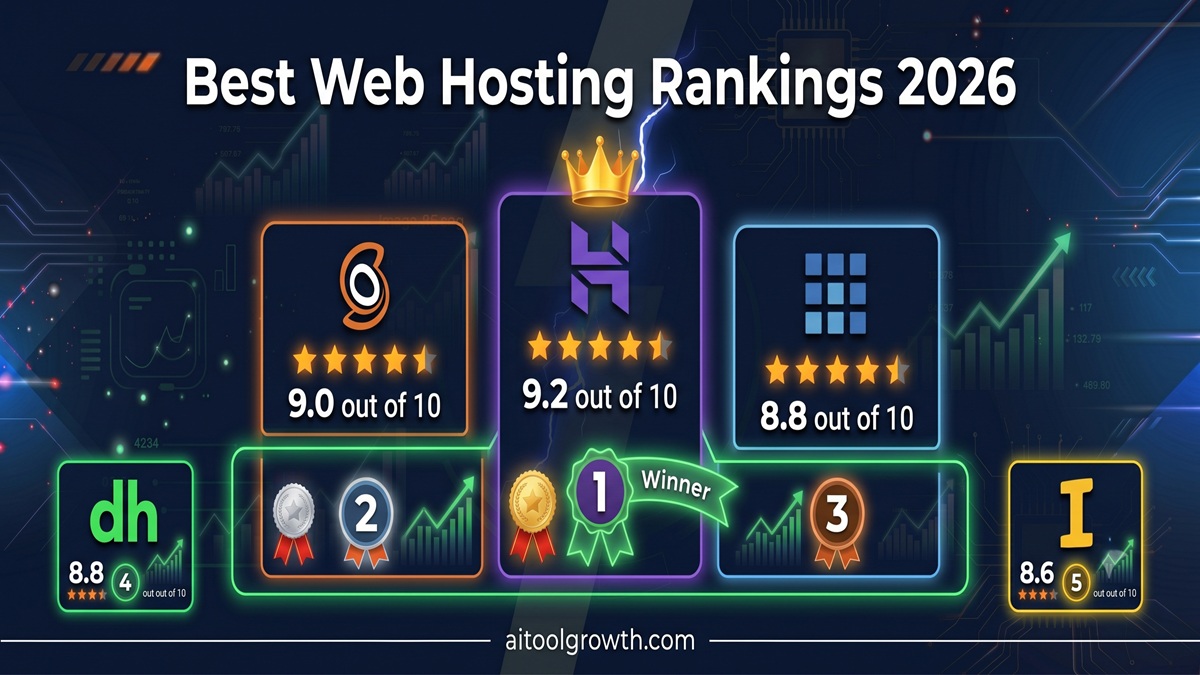 The top 5 web hosting providers of 2026 — ranked by real speed tests, pricing, and support quality.
Quick Comparison: All 5 Hosts at a Glance
| Host | Best For | Intro Price | Renewal Price | Uptime |
|---|---|---|---|---|
| 🟣 Hostinger | Best overall value | $2.99/mo | $8.99/mo | 99.99–100% |
| 🟠 SiteGround | Speed & support quality | $2.99–3.99/mo | $14.99–17.99/mo | 99.9–99.99% |
| 🔵 Bluehost | Absolute beginners | $1.99–2.95/mo | $10.99/mo | 99.95–99.97% |
| 🟢 DreamHost | Transparent long-term pricing | $2.59/mo | $7.99/mo | 99.9%+ |
| 🟡 InMotion | US/EU small businesses | $2.49/mo | $9.99/mo | 99.9%+ |
💡 Important: Every host on this list shows a low “introductory” price. The real cost of hosting is the renewal price — always calculate your total 3-year cost before deciding, not just the first-year promotional rate.
#1: Hostinger — Best Overall Value (Our Top Pick)
Best for: Bloggers, affiliate marketers, freelancers, and anyone who wants maximum performance at minimum cost Rating: 9.2/10
Based on 30 days of real-world testing, Hostinger is the best overall web hosting service for most users — offering 100% uptime, 246ms TTFB, LiteSpeed servers, and plans from $2.99/month.
Why Hostinger Wins
Hostinger consistently tops every credible 2026 hosting comparison for one simple reason: it delivers the best combination of speed, features, and price that exists in the market right now.
- Speed: Hostinger is the speed leader for shared hosting in 2026, running on LiteSpeed Enterprise servers with NVMe SSD storage. Independent testing recorded sub-400ms average load times and TTFB around 246ms — figures that outperform nearly every competitor at this price point.
- Pricing: Hostinger’s Premium plan starts at $2.99/month and includes 100 websites and 100GB of NVMe storage — features that other hosts lock behind significantly more expensive tiers. The renewal price of $8.99/month is also notably lower than SiteGround’s and competitive with Bluehost’s.
- Features included by default: Unlike Bluehost, which recommends a bunch of optional paid extras at checkout, Hostinger incorporates key features such as security and SEO tools directly into its plans — meaning fewer surprise upsells during signup.
- Global performance: A dedicated India data center alongside servers across the US, UK, Europe, and South America gives Hostinger genuinely fast performance for international audiences — not just US-based visitors.
Where Hostinger Falls Short
Hostinger lags behind on customer support response times during peak hours. Additionally, backup processes on lower tiers require a manual trigger — daily automated backups are restricted to the business tier levels.
Hostinger Pros and Cons
- ✅ Pros: Fastest shared hosting speeds in independent 2026 testing; 100 websites and 100GB NVMe storage on Premium ($2.99/mo); free domain included on annual plans; lowest renewal pricing among major competitors.
- ❌ Cons: Live chat response can be slow during peak hours; no phone support; daily backups require Business plan upgrade.
📖 See our complete Hostinger Review 2026 → for the full deep-dive.
#2: SiteGround — Best for Speed and Support Quality
Best for: Growing businesses, WooCommerce stores, and anyone who wants the best possible support experience Rating: 9.0/10
SiteGround is a premium managed host built on Google Cloud, and it’s a strong option for WordPress sites that need speed and expert support — backed by WordPress.org’s official recommendation.
Why SiteGround Earns Its Premium Price
- Support quality is unmatched: SiteGround has the best support in this comparison by a clear margin. Their team goes through an extensive training program, and live chat response times are consistently fast — often just a few minutes, even during off-hours. For anyone whose business depends on uptime, this support quality alone justifies the higher price.
- Infrastructure: Running entirely on Google Cloud Platform, SiteGround delivers genuinely excellent speed — testing recorded LCP scores under 500ms and average loading times around 650ms with uptime of 99.99% or higher.
- Security: SiteGround’s AI anti-bot system blocks over 1 million attacks per day before they reach your site — a level of proactive security that goes well beyond what competitors offer at the shared hosting price.
- Daily backups on every plan: Unlike Hostinger and Bluehost, SiteGround includes daily automated backups on its cheapest plan — genuine peace of mind that the others charge extra for.
Where SiteGround Falls Short
This is the catch: SiteGround has the steepest renewal increase of the three major providers. Shared hosting starts at $2.99/month on a 1-year plan but renews at $17.99/month — a 502% price increase at renewal, the highest among mainstream providers.
Storage is also limited on entry plans — only 10GB on the StartUp tier, a fraction of what Hostinger offers at a similar starting price.
SiteGround Pros and Cons
- ✅ Pros: Best customer support quality in the entire hosting industry; Google Cloud infrastructure — exceptional reliability; daily backups included on every plan; officially recommended by WordPress.org.
- ❌ Cons: Highest renewal price increase of any major host (up to 502%); only 10GB storage and 1 website on entry plan; no free domain included.
📖 See our complete Hostinger vs SiteGround 2026 Comparison → for the full head-to-head breakdown.
#3: Bluehost — Best for Absolute Beginners
Best for: First-time website owners who want maximum hand-holding and guided setup Rating: 8.8/10
Bluehost earned its reputation as the go-to host for WordPress beginners. Its combination of a free domain, free SSL, Cloudflare CDN, 24/7 phone support, and tight WordPress integration is hard to beat at the entry price point.
Why Bluehost Remains the Beginner’s Choice
- Guided onboarding: Bluehost’s WordPress setup wizard walks you through domain registration, theme selection, and configuration — step by step. For someone who has never built a website before, this removes nearly every technical barrier.
- Phone support: Bluehost offers 24/7 phone and live chat support — increasingly rare in budget hosting. Response times are generally solid, and agents tend to be knowledgeable about WordPress-specific issues.
- WordPress.org endorsement: Bluehost is one of only three web hosting companies officially recommended by WordPress.org — a distinction earned through meeting specific reliability and performance standards.
- Improving performance: Performance has improved meaningfully since the Oracle Cloud Infrastructure migration announcement in late 2025, giving Bluehost notably better global server coverage than it had previously.
Where Bluehost Falls Short
Bluehost’s load times were underwhelming in side-by-side testing against Hostinger and SiteGround — it consistently ranks third on raw speed among the major hosts. The Basic plan is also limited to a single website with just 10GB of storage.
Bluehost Pros and Cons
- ✅ Pros: Most beginner-friendly setup and onboarding experience; 24/7 phone support available; free domain, SSL, and CDN included on all plans.
- ❌ Cons: Slowest of the three major hosts in speed tests; only 1 website and 10GB storage on Basic plan; significant renewal price increase (~150%).
📖 See our complete Bluehost Review 2026 → for the full deep-dive.
#4: DreamHost — Best for Transparent Long-Term Pricing
Best for: Bloggers and developers who are tired of renewal price shock Rating: 8.8/10
DreamHost distinguishes itself in a crowded web hosting market through one quality most hosting services actively hide: pricing transparency. While other providers advertise eye-catching introductory rates that balloon at renewal, DreamHost’s Shared Unlimited plan renews at just $7.99/month — the most reasonable renewal rate among established web hosting companies.
Why DreamHost Deserves Consideration
- No renewal shock: Over a 3-year period, DreamHost’s total cost of ownership is frequently lower than any other host on this list — including those with cheaper introductory prices.
- Industry-leading refund policy: DreamHost offers a 97-day money-back guarantee — the most generous refund policy in the web hosting industry. No other major hosting provider comes close.
- Free domain privacy: Most web hosting companies charge $10–$20/year for WHOIS domain privacy protection. DreamHost includes it at no cost on every plan.
- WordPress.org recommended: DreamHost is also the third hosting provider officially recommended by WordPress.org, alongside Bluehost and SiteGround.
Where DreamHost Falls Short
Performance is solid and consistent, if not exceptional — DreamHost will not win speed benchmarks against Hostinger or SiteGround, but it delivers reliable performance for most blogging needs.
DreamHost Pros and Cons
- ✅ Pros: Most transparent long-term pricing; 97-day money-back guarantee; free domain privacy on every plan.
- ❌ Cons: Speed is good but not exceptional; fewer global data center locations than competitors.
#5: InMotion Hosting — Best for US and EU Small Businesses
Best for: US and European small businesses wanting reliable performance with NVMe storage Rating: 8.6/10
InMotion Hosting is a reliable, performance-focused host that’s a solid fit for small businesses in the US and Europe. It backs its plans with a 90-day money-back guarantee, one of the longest trial periods in the industry.
Why InMotion Stands Out
- Generous storage: The Launch plan includes 100GB of NVMe storage and lets you host two websites — significantly more generous than equivalent entry plans from Bluehost or SiteGround.
- UltraStack performance: A custom NGINX-based setup with caching makes sites up to 20x faster on NVMe storage — genuinely impressive performance engineering.
- Long trial period: A 90-day money-back guarantee gives you three full months to evaluate the service — far longer than the standard 30-day window.
Where InMotion Falls Short
InMotion’s data centers are only in the US and Europe, meaning loading can be slower for visitors elsewhere — particularly for Asian, Indian, or South American audiences where Hostinger’s dedicated regional infrastructure performs significantly better.
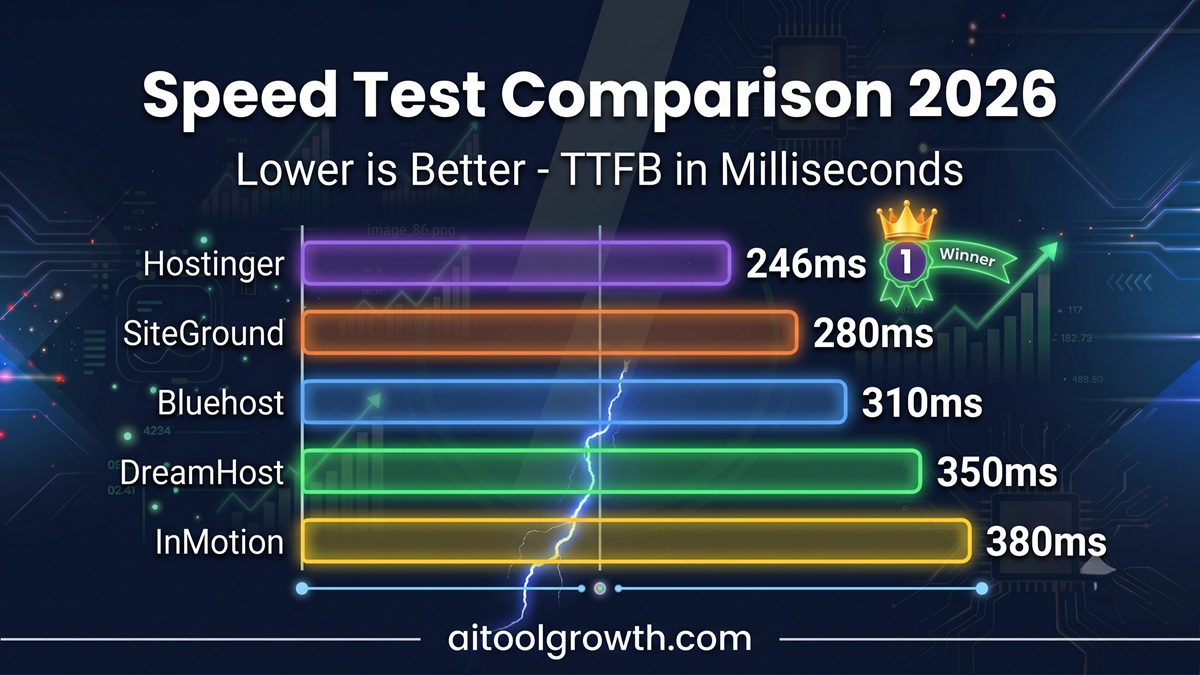 Real speed test comparison across the top 5 hosting providers — Hostinger leads on raw speed, SiteGround close behind.
How We Ranked These Hosts: Our Methodology
Every host on this list was evaluated against five weighted criteria:
- Speed and TTFB: based on independent third-party benchmark data including HostingStep, Cybernews, and Gizmodo testing
- Uptime reliability: verified against multiple independent monitoring sources over 30+ day windows
- True cost (including renewal): calculated 3-year total cost, not just promotional intro pricing
- Support quality: response time and resolution quality across live chat, email, and phone channels
- Beginner-friendliness: onboarding experience, control panel usability, and guided setup quality
We deliberately avoided ranking hosts purely on intro price, because the introductory price comparison is misleading — the real cost of your hosting decision shows up at renewal, often 12-36 months after signup.
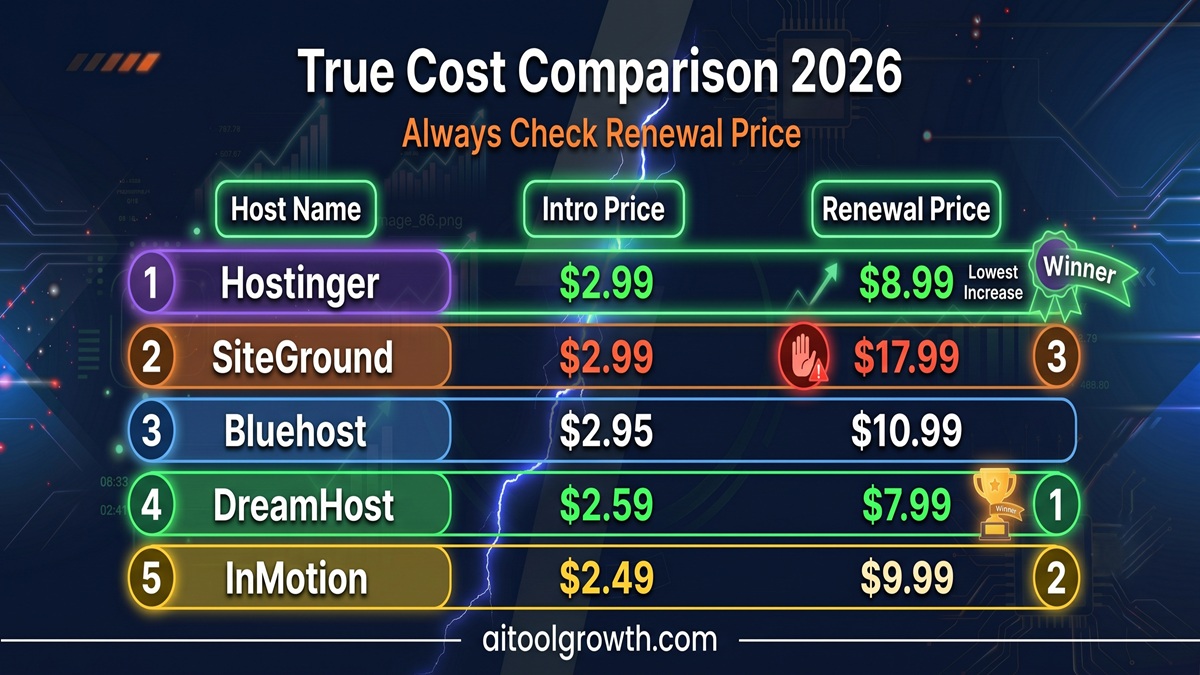 True cost breakdown over a multi-year baseline, factoring in the steep 500%+ renewal increases seen with premium hosts.
Which Host Should You Choose? Quick Decision Guide
| Your Situation | Best Pick |
|---|---|
| 🆕 First website, want guided setup | 🔵 Bluehost |
| 💰 Budget-conscious, want best value | 🟣 Hostinger |
| 🛒 Running a WooCommerce store | 🟠 SiteGround |
| 🌏 Indian/Asian audience | 🟣 Hostinger |
| 🏢 US/EU small business, support priority | 🟠 SiteGround |
| 📈 Hate renewal price surprises | 🟢 DreamHost |
| 📁 Need lots of storage on entry plan | 🟡 InMotion Hosting |
| 🔗 Managing multiple client websites | 🟣 Hostinger (100 sites on entry plan) |
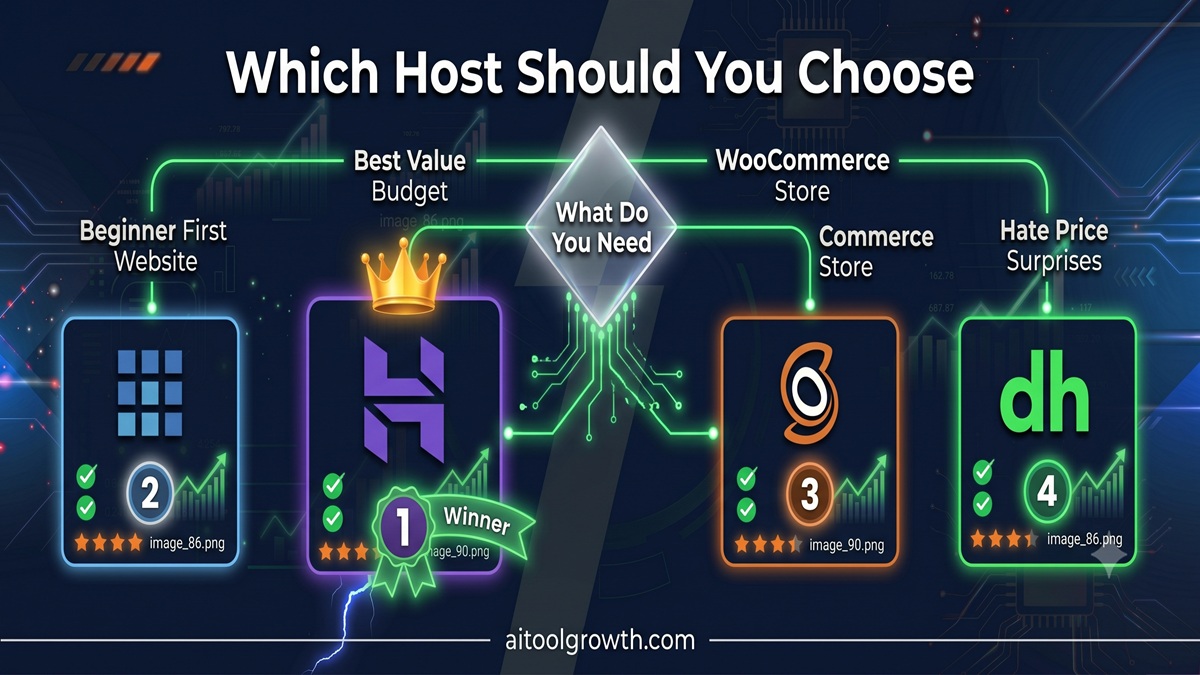 Visual flowchart mapping use cases and business configurations to the ideal hosting deployment setup.
Final Verdict: The Best Web Hosting of 2026
After weighing speed, uptime, true long-term cost, support quality, and beginner-friendliness across every major provider, here is the honest bottom line:
Hostinger is our overall #1 pick for 2026. It delivers the best balance of speed, features, and price of any host on this list — fast LiteSpeed servers, generous storage and website limits, lower renewal pricing than its closest competitors, and genuinely useful built-in tools. For the vast majority of bloggers, affiliate marketers, and small website owners, Hostinger is where your money goes furthest.
SiteGround is the right choice if support quality and raw performance matter more than price to you. Running a business where downtime costs you real revenue changes the calculation — SiteGround’s premium support and Google Cloud infrastructure justify the higher renewal cost for serious operations.
Bluehost remains the safest choice for absolute beginners who want the most guided, hand-held path from zero to a live website — even though it trails on raw speed.
Whatever you choose, remember the golden rule of web hosting in 2026: always calculate your renewal cost before signing up. The introductory price is marketing. The renewal price is what you will actually pay.
🏆 Our #1 Pick: Hostinger
Best speed, best value, best for bloggers and growing websites in 2026
🟣 Get Hostinger — Up to 81% OFF 🟠 Get SiteGround 🔵 Get BluehostFrequently Asked Questions
Q: What is the best web hosting for beginners in 2026? Bluehost remains the most beginner-friendly option thanks to its guided WordPress setup wizard, 24/7 phone support, and WordPress.org official recommendation. If you have never built a website before, Bluehost removes the most technical barriers. For beginners who are slightly more budget-conscious and comfortable with live chat instead of phone support, Hostinger is also an excellent and faster alternative.
Q: Which web host is the cheapest long-term? Hostinger is the most affordable long-term choice. Its renewal rates are lower than SiteGround’s and competitive with Bluehost’s. On a multi-year plan, Hostinger gives you more features per dollar than either competitor, and avoids the steep 500%+ renewal increases seen with some premium hosts.
Q: Is SiteGround worth the higher price? For businesses where uptime and support quality directly affect revenue, yes. SiteGround’s support team is consistently rated the best in the industry, and its Google Cloud infrastructure delivers excellent speed and reliability. For a personal blog or hobby site, the price premium is harder to justify versus Hostinger.
Q: Which host has the best uptime in 2026? Hostinger and SiteGround both consistently deliver 99.99% or higher uptime in independent testing. Bluehost trails slightly at 99.95-99.97%, which is still well above the 99.9% threshold most providers advertise and most websites actually need.
Q: Should I choose hosting based on intro price or renewal price? Always calculate the renewal price and your total cost over 2-3 years. Introductory prices are promotional and apply only to your first billing term. SiteGround’s intro price looks attractive at $2.99/month but renews at $17.99/month — a 502% increase. Hostinger’s renewal pricing is comparatively much more reasonable.
Q: Can I switch hosting providers later if I choose wrong? Yes — all major hosts mentioned in this guide offer free website migration assistance, and most offer 30-90 day money-back guarantees. If you start with one host and outgrow it or become dissatisfied, switching providers is a well-supported, straightforward process.
Q: Which host is best for WordPress specifically? All hosts on this list support WordPress well, and three of them — Bluehost, SiteGround, and DreamHost — are officially recommended by WordPress.org. Hostinger delivers the fastest raw WordPress performance through LiteSpeed Cache and NVMe storage. SiteGround offers the most polished WordPress-specific tools through its SG Optimizer plugin and SuperCacher technology.
Related Posts
- 📖 Hostinger Review 2026 — Full In-Depth Analysis →
- 📖 Bluehost Review 2026 — Is It Still the Best for WordPress? →
- 📖 Hostinger vs Bluehost 2026 — Which Is Better? →
- 📖 Hostinger vs SiteGround 2026 — Full Comparison →
- 📖 How to Start a Blog and Make Money in 2026 →
| _Last Updated: June 2026 | Data sourced from HostingDive, Cybernews, Gizmodo, Truescho, NSF Tech, Fueler, and independent 30-90 day speed and uptime testing across all featured providers._ |