How to Start a Blog and Make Money in 2026 (Complete Beginner's Guide)
How to start a blog and make money in 2026 — step by step from niche to first income. Complete beginner's guide with tools, hosting, and monetization strategies.

⚠️ Affiliate Disclosure: This post contains affiliate links. If you purchase hosting or tools through my links, I may earn a small commission at no extra cost to you. I only recommend tools I personally use and believe in.
Introduction: Is Blogging Still Worth Starting in 2026?
Let me answer the most important question first — the one every beginner asks before spending a single rupee on hosting.
Yes. Blogging in 2026 is absolutely worth starting. But not in the way it worked five years ago.
The bloggers failing in 2026 are the ones who treat blogging like it is 2019 — publishing thin, keyword-stuffed articles and hoping traffic shows up. Google’s algorithm in 2026 rewards expertise, experience, authority, and trustworthiness — commonly abbreviated as EEAT. Generic content no longer ranks. Genuinely helpful, specific, well-structured content does.
The bloggers succeeding in 2026 are the ones who combine consistent content creation with smart monetization from day one. To start a profitable blog, you need a clear niche, a smart setup, a content strategy, and a monetization plan from the beginning — not as an afterthought months later.
Blogging still earns real income. Thousands of bloggers continue earning money every month through various income sources, and unlike social media where content disappears from people’s feeds within hours, blog articles can continue attracting visitors for years.
This guide walks you through exactly how to start a blog from zero to first income in 2026 — the tools, the setup, the content strategy, and the monetization paths that actually work.
The complete 2026 blogging roadmap — from choosing your niche to earning your first income.
Step 1: Choose Your Niche — The Decision That Determines Everything
Your niche is the specific topic your blog covers. This is the single most important decision you will make — it determines your traffic potential, your monetization options, your competition level, and whether you can sustain content creation for 12+ months.
The 3 Qualities of a Profitable Blog Niche
- Commercial value: Are there products, services, or programs to promote? Can you earn affiliate commissions, display ad revenue, or sell digital products within this topic? A niche with no products to recommend is a niche with limited income potential.
- Search demand: Are people actively searching for information in this niche? Use Google’s autocomplete, Reddit threads, and YouTube search volume as quick validation tools. If people are searching questions, they are looking for blog content answering those questions.
- Your genuine knowledge or interest: You will write 50-100+ articles about this topic. Choosing a niche purely for money without any authentic interest or expertise leads to burnout within 3-6 months — one of the most common reasons new blogs are abandoned.
Best Blog Niches for 2026
| Niche | Earning Potential | Competition | | :— | :— | :— | | AI Tools & Software | ⭐⭐⭐⭐⭐ | Medium | | Personal Finance | ⭐⭐⭐⭐⭐ | High | | Web Hosting & Tech | ⭐⭐⭐⭐⭐ | Medium-High | | Health & Wellness | ⭐⭐⭐⭐ | High | | Digital Marketing | ⭐⭐⭐⭐⭐ | Medium | | Travel | ⭐⭐⭐ | Very High | | Food & Recipes | ⭐⭐⭐ | Very High | | Home Improvement | ⭐⭐⭐⭐ | Medium |
💡 Pro tip from 2026 blogging reality: Take the blog niche you are thinking about and come up with 5-10 keyword phrases or blog topics within that niche. This creates a keyword cluster. A blog about AI tools might tackle topics like “best AI writing tools,” “Jasper AI review,” “Grammarly vs QuillBot,” and so on. If you can generate 20+ topic ideas easily, the niche is right for you.
Step 2: Choose Your Blogging Platform — Only One Right Answer
If your goal is to build a profitable blog, WordPress.org remains the most recommended platform in 2026. More than 40% of websites worldwide use WordPress because it offers unmatched flexibility, thousands of themes and plugins, and excellent ability to grow and monetize.
WordPress.org (self-hosted) is the correct choice for any blogger serious about making money. Here is why:
- Complete ownership — you own your domain, your content, and your data
- Full monetization control — add affiliate links, Google AdSense, sponsored posts, digital products without platform restrictions
- SEO flexibility — install any SEO plugin, customize technical settings, control your site speed
- No platform risk — free platforms can shut down, change rules, or ban monetization at any time
Free platforms to avoid for monetization:
- Blogger — no real monetization control
- WordPress.com (not .org) — limited plugins, restricted ads
- Wix or Squarespace — expensive, limited SEO control, no ownership
Step 3: Get Web Hosting — Your Blog’s Foundation
Web hosting is where your blog lives on the internet. The hosting you choose directly affects your site speed, uptime, security, and ultimately your Google rankings.
For new bloggers in 2026, Hostinger is our recommended starting point — consistently the top-ranked hosting provider for value, speed, and beginner-friendliness.
Why Hostinger for New Bloggers
- $2.99/month on the Premium plan — affordable for any budget
- 100 websites included — grow without upgrading
- 100 GB NVMe storage — fastest storage available on shared hosting
- Free domain for the first year — saves $15-20
- LiteSpeed servers — 30-50% faster than Apache servers competitors use
- Free SSL certificate — required for Google rankings and reader trust
- One-click WordPress install — live in under 2 minutes
- India data center — faster loading for Indian audiences
- 30-day money-back guarantee — zero risk
How to Set Up Hosting (Step by Step)
- Step 1: Go to Hostinger.com → Select Premium Web Hosting
- Step 2: Choose your billing period — 12 or 24 months for the best price
- Step 3: Register a domain name:
- Keep it short — under 15 characters
- Make it memorable and brandable
- Use .com whenever possible
- Avoid hyphens and numbers
- Step 4: Complete checkout with your payment details
- Step 5: Check your email for login credentials to hPanel (Total setup time: under 15 minutes)
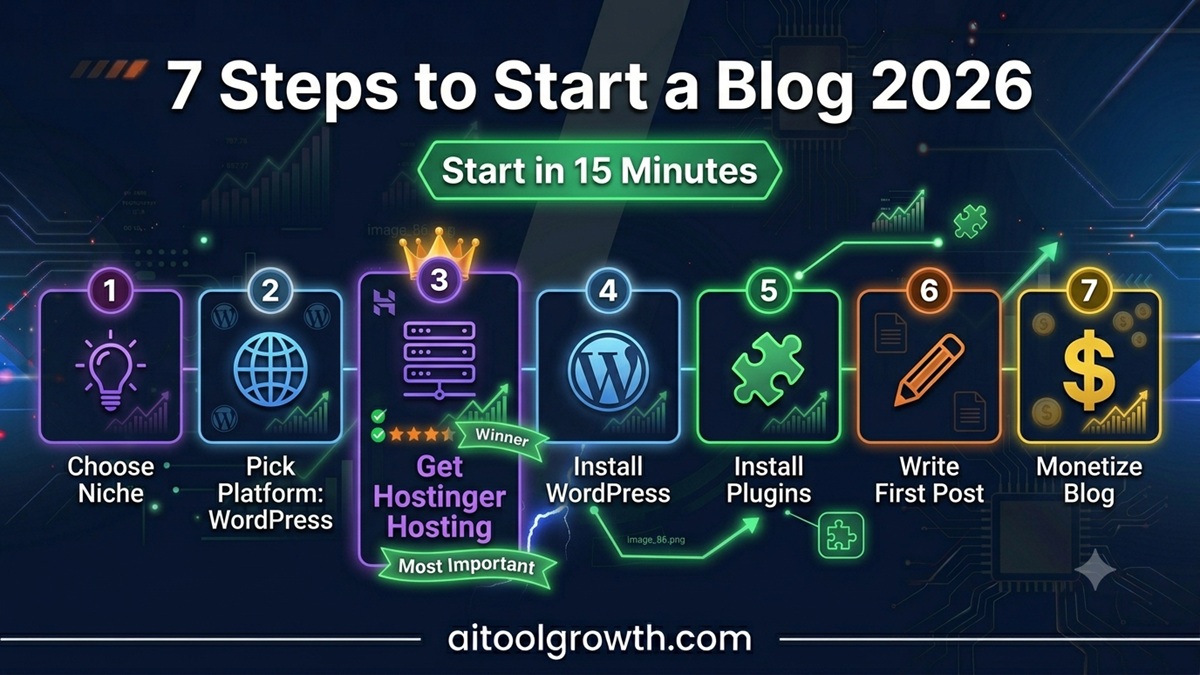 The 7-step blog setup process — from hosting signup to publishing your first post in 2026.
Step 4: Install WordPress and Set Up Your Blog
Once your Hostinger account is active, installing WordPress takes exactly 2 minutes:
- Log into hPanel (Hostinger’s dashboard)
- Click “WordPress” in the website section
- Click “Install” → Fill in:
- Blog title (can be changed later)
- Admin username and password
- Admin email address
- Click “Install” — WordPress is live instantly
- Log into your WordPress dashboard at
yoursite.com/wp-admin
Essential WordPress Settings (Do These First)
- Permalinks: Go to Settings → Permalinks → Select “Post name” → Save Changes. This gives you clean URLs like
yoursite.com/hostinger-reviewinstead ofyoursite.com/?p=123. - Install these 5 plugins immediately:
| Plugin | Purpose | Cost |
|---|---|---|
| Yoast SEO | On-page SEO optimization | Free |
| WP Rocket / LiteSpeed | Site speed optimization | Free/Paid |
| Wordfence Security | Security and malware protection | Free |
| UpdraftPlus | Automated backups | Free |
| WP Smush | Automatic image compression | Free |
- Choose a theme: For a blog focused on reviews and affiliate content, choose a clean, fast-loading theme. Popular free options include Astra, GeneratePress, and Kadence.
Step 5: Create Your Content Strategy — What to Write First
Most new bloggers make the same critical mistake: they write whatever they feel like and hope people find it. In 2026, this approach produces zero traffic.
A content strategy means choosing specific keywords before writing, understanding search intent, and building topical authority systematically.
The 3-Type Content Framework
Type 1: Pillar Posts (Traffic magnets) Long, comprehensive guides targeting broad keywords. Examples: “Best AI Tools for Bloggers 2026”, “How to Start a Blog in 2026”. These build authority and attract links from other websites.
Type 2: Review Posts (Income generators) Detailed single-tool reviews targeting buyer-intent keywords. Examples: “Hostinger Review 2026”, “Jasper AI Review 2026”. These convert readers into affiliate customers.
Type 3: Comparison Posts (Double income) Two-tool comparisons targeting comparison keywords. Examples: “Hostinger vs Bluehost 2026”, “Grammarly vs QuillBot 2026”. These contain affiliate links for both tools — double the conversion opportunity.
Your First 10 Posts — The Proven Order
- Post 1: Pillar → “Best [Tool Category] 2026”
- Post 2: Review → Top tool in your niche
- Post 3: Review → Second tool
- Post 4: Comparison → Tool 1 vs Tool 2
- Post 5: Review → Third tool
- Post 6: Pillar → “How to use [topic]”
- Post 7: Review → Fourth tool
- Post 8: Comparison → Two more tools
- Post 9: Pillar → “Best [related category] 2026”
- Post 10: Review → Fifth tool
This structure builds topical authority quickly while maximizing affiliate income potential from day one.
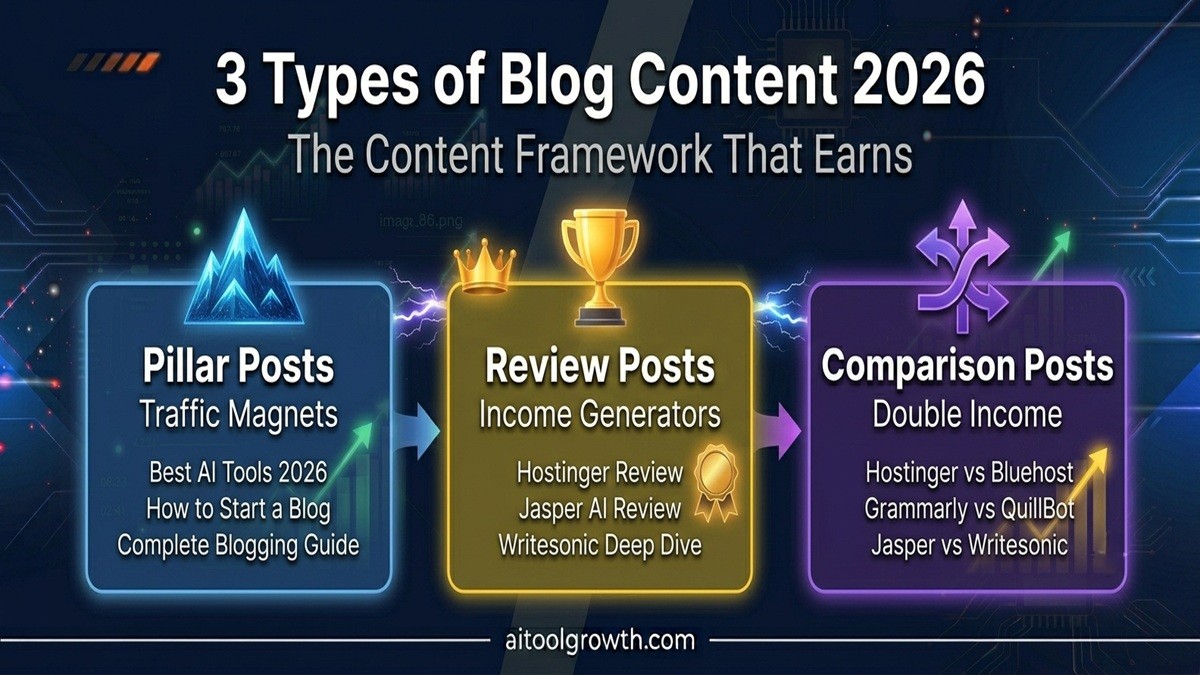 The 3-type content framework for affiliate blogs — pillar posts build authority, reviews generate income, comparisons double it.
Step 6: Write Posts That Actually Rank in 2026
Google’s 2026 algorithm rewards content that demonstrates genuine expertise and helps readers make real decisions. Here is the structure of a high-ranking blog post:
The Anatomy of a Ranking Blog Post
- SEO-optimized title: Include the primary keyword and the year. Example: “Hostinger Review 2026: Is It Worth the Money?”
- Strong introduction: Hook the reader in the first 100 words. State what the post covers and who it is for. Include your primary keyword naturally.
- Clear heading structure: Use H2 for main sections, H3 for sub-sections. Headings should include related keywords naturally.
- Real data and specifics: Vague claims do not rank. Include actual pricing, real speed test numbers, specific feature names, and concrete examples.
- Pros and Cons: Balanced assessments build trust. Never write a purely positive review — acknowledge genuine limitations.
- Comparison tables: Structured data improves readability and often earns featured snippets in Google search results.
- FAQ section: Answers to common questions capture People Also Ask positions in Google — a major source of additional traffic.
- Clear conclusion and CTA: End with a specific recommendation and a call-to-action with your affiliate link.
Recommended Word Count by Post Type
| Post Type | Minimum Words | Ideal Words | | :— | :— | :— | | Tool Review | 2,000 | 2,500–3,000 | | Comparison Post | 2,500 | 3,000–3,500 | | Pillar/Listicle | 2,500 | 3,000+ | | How-To Guide | 1,500 | 2,000–2,500 |
Step 7: Drive Traffic to Your Blog
Publishing is not enough. You need to actively drive traffic in the first 3-6 months while Google builds trust in your new domain.
Google Search Console — Do This on Day 1
- Go to search.google.com/search-console
- Add your domain property
- Verify ownership via the HTML tag method
- Submit your sitemap (
yoursite.com/sitemap.xml) - Request indexing for each new post after publishing
Keyword Research — Find What People Are Searching
Before writing any post, identify its target keyword using Google autocomplete, People Also Ask boxes, or free tools like Ubersuggest. Target keywords with:
- Search volume of 100-5,000/month
- Keyword difficulty under 40
- Commercial or transactional intent
Pinterest — Fastest Free Traffic for New Blogs
Pinterest is a search engine, not just social media — and it sends traffic to new blogs faster than Google. Create vertical pins (1000×1500px) for every blog post and publish 3-5 pins per week. Traffic can begin within weeks.
Internal Linking — Often Overlooked, Always Valuable
Every new post should link to 2-3 existing posts. This passes authority between your pages and helps Google understand your site’s structure.
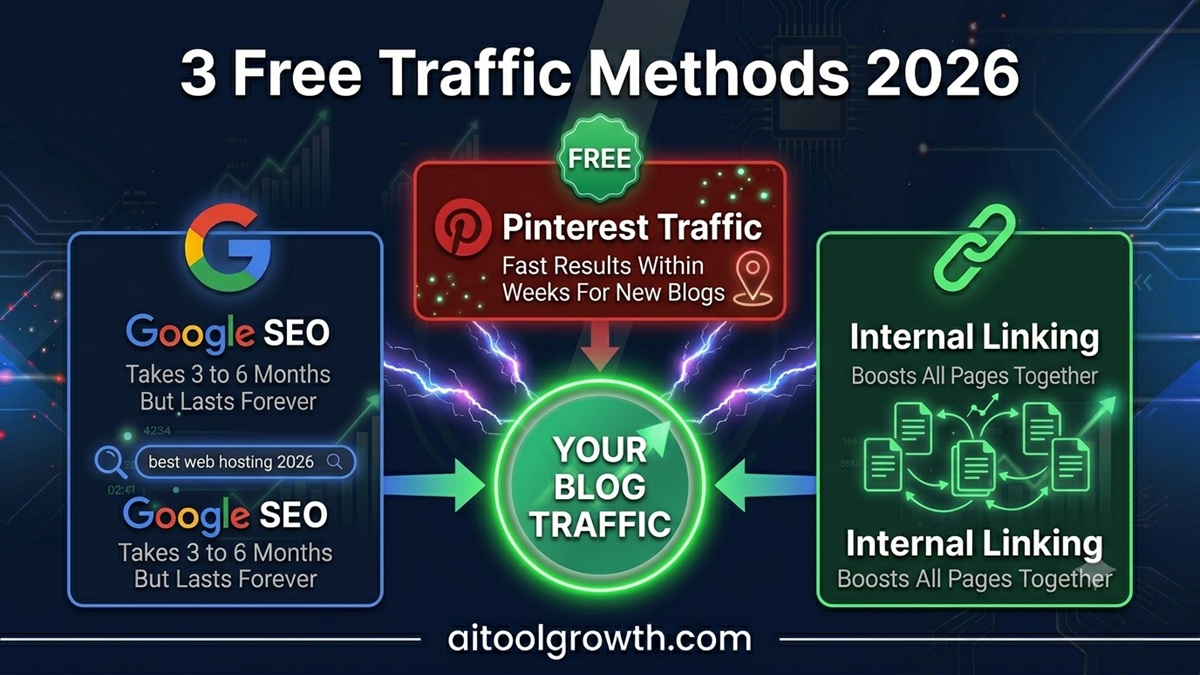 Three powerful traffic sources for new bloggers in 2026.
Step 8: Monetize Your Blog — 4 Proven Income Streams
Diversifying your blog income with multiple monetization methods creates a more stable and profitable blogging business.
Income Stream 1: Affiliate Marketing (Best for Beginners)
Affiliate marketing is recommending products and earning a commission when readers purchase through your link. It is the fastest path to meaningful blog income for new bloggers.
Best affiliate programs for an AI Tools blog: | Program | Commission | Cookie | | :— | :— | :— | | SEMrush | $200/sale + $10/trial | 120 days | | Hostinger | Up to $150/sale | 30 days | | Jasper AI | 30% recurring | 30 days | | Surfer SEO | 25% lifetime recurring | 60 days | | Grammarly | $20/paid signup | 90 days |
Income Stream 2: Google AdSense (Passive Income)
Google AdSense displays relevant ads on your blog and pays you each time a visitor clicks. Income scales automatically with traffic.
Expected AdSense earnings by traffic level: | Monthly Visitors | Estimated Monthly AdSense Income | | :— | :— | | 1,000 | $5–$15 | | 5,000 | $25–$75 | | 10,000 | $50–$150 | | 50,000 | $250–$750 | | 100,000 | $500–$1,500+ |
Income Stream 3: Sponsored Posts
Once your blog has established traffic (typically 5,000+ monthly visitors), brands will pay you to write posts featuring their products. Rates range from $50–$500+ per post depending on your traffic and niche authority.
Income Stream 4: Digital Products
Create and sell your own ebooks, templates, courses, or tools. This is the highest-margin income stream — no commission sharing, 100% of revenue is yours.
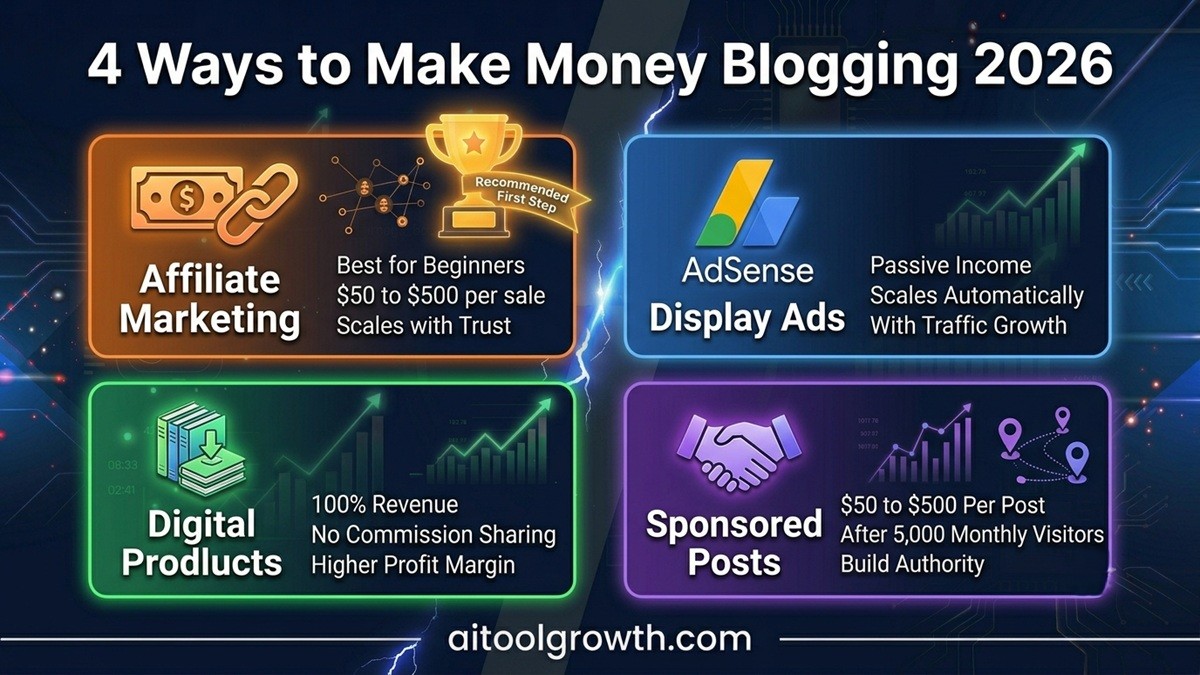 The 4 main income streams to monetize your blog in 2026.
What Does a Blog Actually Earn? Realistic Expectations
Bloggers can make up to $5,450 per month on average after around five to ten years. Do not be discouraged if you are just starting out.
Here is a realistic income timeline based on consistent publishing (2 posts per week):
| Month | Posts Published | Monthly Traffic | Monthly Income |
|---|---|---|---|
| 1-3 | 8-24 | 50-200 | $0 (building) |
| 4-6 | 32-48 | 500-2,000 | $50-200 |
| 7-12 | 64-96 | 3,000-10,000 | $200-800 |
| 13-24 | 100-192 | 15,000-50,000 | $1,000-3,000 |
| 24+ | 200+ | 50,000+ | $3,000-10,000+ |
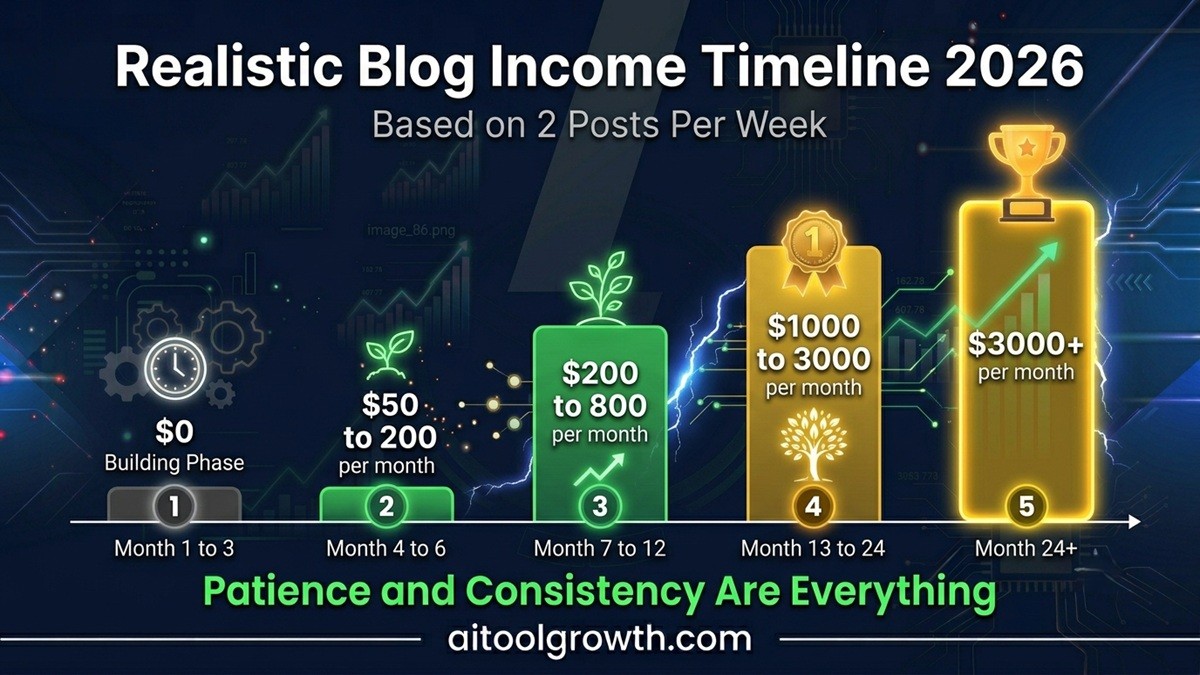 Blogging is a long-term strategy, not a quick-money method. Those who stay consistent see strong results.
The Tools You Need to Start (Complete Checklist)
| Tool | Purpose | Cost |
|---|---|---|
| Hostinger | Web hosting + domain | $2.99/mo |
| WordPress | Blogging platform | Free |
| Yoast SEO | SEO optimization | Free |
| Grammarly | Writing quality | Free |
| Canva / Designer | Blog images | Free |
| TinyPNG | Image compression | Free |
| Search Console | SEO monitoring | Free |
Total minimum cost to start: $2.99/month. Everything else is free.
Common Mistakes That Kill New Blogs (Avoid These)
- Choosing a niche with no monetization path: Passion without commercial potential produces content without income.
- Publishing without keyword research: Writing what you feel like instead of what people search for produces zero traffic.
- Quitting during the Google sandbox period: New blogs receive minimal traffic for the first 3-6 months. Most quit right before the traffic inflection point.
- Thin content under 1,500 words: 2,000-word detailed posts consistently outperform 500-word thin articles.
- No internal linking structure: Publishing posts in isolation wastes authority signals.
Final Verdict: Should You Start a Blog in 2026?
Yes — if you approach it correctly.
You can get a professional blog live for under $30 for the first year — there has never been a lower barrier to entry. What separates successful bloggers from abandoned blogs is simply consistent, strategic execution.
Start today. The best time to plant a tree was 10 years ago. The second best time is now.
🚀 Ready to Start Your Blog?
Get your blog live today with Hostinger — the fastest, most affordable hosting for new bloggers in 2026
Get Hostinger — Up to 81% OFF →Premium plan from $2.99/month. Free domain included. 30-day money-back guarantee.
Frequently Asked Questions
Q: How much does it cost to start a blog in 2026? The minimum cost is your hosting — Hostinger’s Premium plan starts at $2.99/month, which includes your free domain. You can launch a professional blog for under $36 for the entire first year.
Q: How long does it take to make money blogging? Most bloggers see their first affiliate commissions within 3-6 months. Consistent income of $500-1,000/month usually appears around Month 12-18 with 2+ posts per week.
Q: Do I need to be a good writer to start a blog? No — clear, helpful writing matters far more than literary talent. Most successful blog posts are informational and structured.
Q: Can I start a blog without showing my face? Yes — the majority of successful affiliate and review blogs are faceless. Focus on the quality of your content rather than personal brand building.
Related Posts
- 📖 Hostinger Review 2026 — Best Budget Hosting? →
- 📖 Best Web Hosting 2026 — Top 5 Picks →
- 📖 7 Best AI Writing Tools for Bloggers 2026 →
- 📖 Grammarly Review 2026 — Is It Worth It? →
- 📖 Top 5 AI Tools for Bloggers in 2026 →
| _Last Updated: July 2026 | Data sourced from independent blogging surveys._ |